Astro: Astrology & Horoscope
- 4.5
- Rating
- 1.00M
- Installs
- Free
- Price

 Analysis by App-foxy
I approached Astro: Astrology & Horoscope as a lifestyle app rather than as a source of unquestionable answers. Its appeal is easy to understand: instead of opening several separate tools, you can explore a daily horoscope, birth-chart material, tarot, zodiac compatibility, and a moon calendar in one place. I found that combination more useful for reflection and planning than for making serious decisions.
The app is free to download, which makes it simple to try without committing money at the start. It is developed by Talentin, carries an Everyone age rating, and has built a sizeable audience, with more than a million installs and an average rating of 4.4 from roughly 16 thousand ratings. Those figures suggest that the format works for many people, but they do not prove that every interpretation will feel personal or accurate. My experience was best when I treated the content as a prompt for thinking, not as a fixed description of my future.
What Astro actually offers in everyday use
I find Astro most useful when I give each visit a small purpose instead of treating it as a feed to browse for answers. In this section, I’ll look at how a simple daily check-in can lead into more focused use, while keeping the readings in perspective. That routine also makes it easier to decide which settings deserve attention before the app becomes part of a habit.
You May Also Like

 Blood Strike: 2.5 Anniversary
Blood Strike’s Loadouts Turn Every Drop Into a Tactical Gamble
A close look at Blood Strike’s custom loadouts: how fast access to signature weapons reshapes its battle royale rhythm, rewards preparation, and narrows the gap between fights.

 Pandora - Music & Podcasts
Pandora’s Music Is Easy to Start, but Harder to Recover
Pandora’s strength is its low-effort path from a seed to a station. Its weak spot is how much confidence it asks you to place in connection, setup, and quiet recovery.

 8 Ball Pool
 Is Built on Rivalries, Rematches, and Routine
A close look at the rivalries, rematches, shared routines, and unanswered safety questions that turn a quick pool match into a persistent mobile community.

 Samsung Music
’s Quiet Strength Is Playing What You Already Own
Its reach comes less from spectacle than from dependable access to a personal library. That simplicity is both the app’s strongest retention engine and its ceiling.

 AccuWeather: Weather Radar
AccuWeather Review: A Quick, Clear Forecast for Everyday Decisions
For everyday plans, the best forecast is the one you can understand quickly. AccuWeather makes rain timing, radar, and local conditions easy to act on, with a few trade-offs.

 Hill Climb Racing
Why Hill Climb Racing Still Turns Crashes Into One More Run
A tiny car, a bumpy hill and one more upgrade: Hill Climb Racing keeps resurfacing because its simple chaos makes every near-miss feel personal.
More From Our News Desk



A broad set of tools in one calm space
The strongest part of Astro is the way its subjects fit together. A daily horoscope gives you a quick entry point, while a birth chart invites a slower look at personality and patterns. Tarot adds a more question-oriented style, zodiac compatibility shifts attention toward relationships, and the moon calendar gives the experience a time-based rhythm.
That range matters because people rarely use astrology in exactly the same way every day. I might want a short reading in the morning, then return later to think about a relationship question or check a lunar date. Having those paths together feels more convenient than switching between a general horoscope app, a tarot app, and a calendar.
At the same time, the breadth can make the experience feel less focused than a specialist tool. Someone who wants only a detailed birth chart may prefer an app built around chart analysis. Someone interested only in tarot may want a dedicated reader with a larger emphasis on spreads and card explanations. Astro is more appealing as an all-rounder than as a deep technical instrument for one tradition.
A realistic morning routine
My most practical use case was a short morning check-in. I would read the daily material, note one idea that seemed relevant, and then leave the app rather than repeatedly searching for confirmation. For example, if the reading emphasized communication, I could use that as a reminder to be clearer in a difficult conversation at work. The value came from turning a vague theme into a small, sensible action.
The moon calendar can support a similar routine for users who like marking phases or planning personal rituals. I would not use it as a replacement for a normal calendar, task manager, or medical schedule, but it can add a reflective layer to an existing routine. That distinction is important: Astro works best beside practical tools, not instead of them.
Why the birth chart needs patience
The birth-chart area is likely to be more rewarding for a curious newcomer than for an experienced astrology reader who expects exhaustive technical detail. A chart can be interesting because it gives you several themes to compare with your own experience, but the interpretation is easy to read too literally.
I recommend taking notes on the parts that genuinely resonate and revisiting them later. Do not accept every sentence as a diagnosis of your personality. A useful technique is to separate observations into three groups: things you recognize, things you are unsure about, and things that do not fit. That simple habit reduces the temptation to bend every life event around the reading.
There is also a practical reason to slow down. Birth-chart content can feel more authoritative than a short daily horoscope because it appears personal. Personalization can make a general interpretation feel unusually convincing. I found it healthier to ask, “Does this help me notice something useful?” rather than, “Is this objectively describing me?”
Tarot and compatibility without overreading them
Tarot is most useful here as a structured way to frame a question. Instead of asking whether a relationship will definitely succeed, I would ask what dynamic deserves attention or what assumption I might be overlooking. That wording leaves room for judgment and keeps the reading from becoming a substitute for an honest conversation.
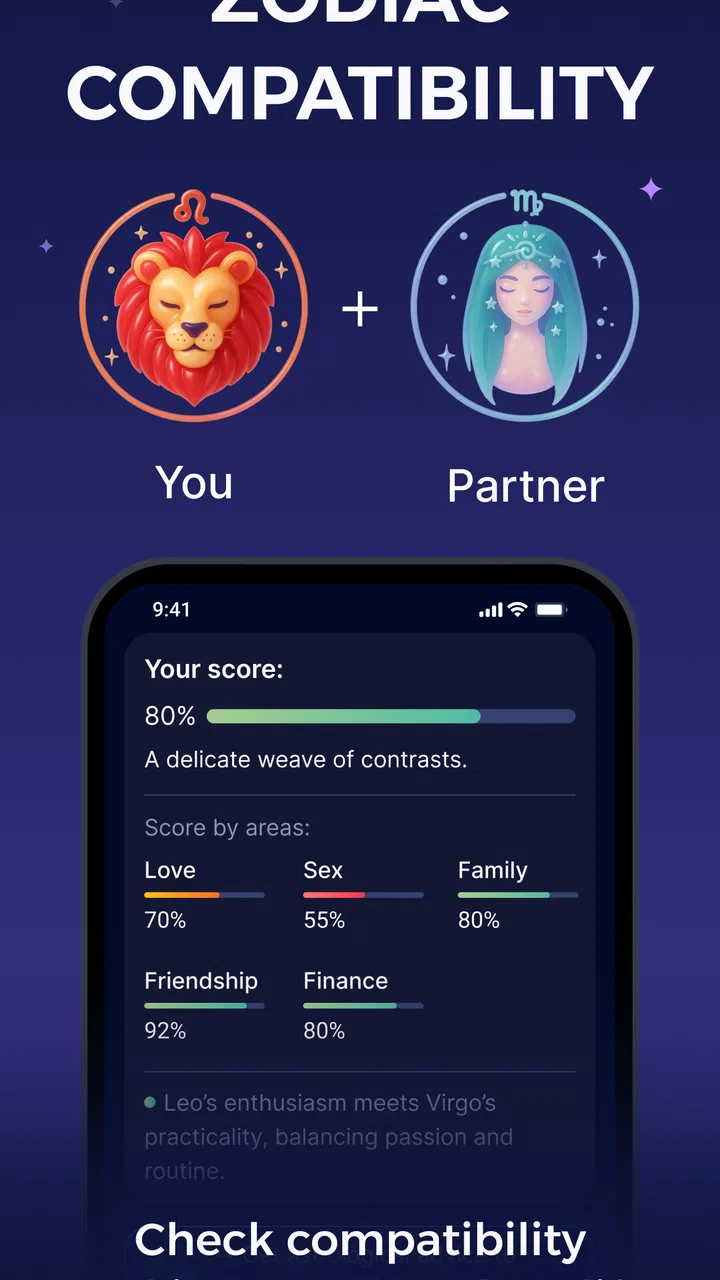
The same caution applies to zodiac compatibility. Compatibility sections can be entertaining and may help start a conversation, but a sign pairing cannot capture communication habits, boundaries, shared responsibilities, or the history between two people. I would never use a low compatibility result as a reason to end a relationship, nor a favorable one as proof that a difficult situation will resolve itself.
A useful trade-off is that these features make the app approachable for casual users, while their broad interpretations may disappoint readers looking for rigorous relationship analysis. If you want a neutral framework for discussing a partnership, a journaling prompt or direct conversation will usually tell you more than a zodiac match.
Trust begins with what you choose to share
Astrology apps can invite personal information because birth-chart readings are more meaningful when the relevant details are entered accurately. That creates a data-sensitive moment: before typing anything, I would consider whether the requested information is necessary for the feature I want to use and whether I am comfortable keeping it inside this kind of app.
I avoid entering details simply because a form makes them available. If I only want a general daily reading, I see no reason to provide more personal context than that feature needs. If I decide to explore a chart, I would review each field carefully and avoid adding information about another person unless I have a clear reason and their permission.
This is not a claim about hidden data practices; it is a sensible habit for any app that may become connected with personal identity, relationships, or sensitive beliefs. The safest approach is to make deliberate choices rather than treating every optional-looking prompt as harmless.
Account control and visible choices
When I review an app in this category, I pay attention to whether I can understand what I am doing before continuing. Astro is easier to approach when I move through one feature at a time instead of rushing through every setup screen. I would read prompts, check what information is being requested, and avoid granting access that does not match the feature I intend to use.
I also recommend checking the account and device settings directly if you decide to keep using the app. Look for controls related to notifications, saved information, purchases, and any account sign-in choices that appear during use. I would not assume that deleting the app automatically handles every account or subscription matter; those are separate actions and should be reviewed independently.
This is especially relevant because the app is free but offers in-app purchases ranging from about six dollars to around fifty dollars per item. I would treat the free download as an opportunity to evaluate the basic experience, not as a promise that every part of the app remains free. Before confirming a purchase, check the wording, the amount, and whether the item is genuinely useful to your intended routine.
Notifications can change the tone of the experience
Notifications are another small but important point of user agency. A daily reminder may be welcome if you enjoy a morning ritual, but it can become distracting if the app starts shaping your attention throughout the day. I prefer enabling only the alerts that support a specific habit and turning off the rest.
If you find yourself checking readings repeatedly because you are anxious about a decision, that is a good moment to pause notifications. The app should be something you open intentionally, not something that keeps pulling you back for reassurance. A notebook, a conversation with someone you trust, or professional advice is more appropriate when the issue involves health, money, safety, or major legal and personal consequences.
What the age rating means in practice
The Everyone rating makes Astro approachable for a broad audience, but an age label does not decide whether the content is suitable for every individual situation. Younger users may still need guidance about treating horoscope and tarot interpretations as entertainment or reflection rather than certainty.
Adults can benefit from the same boundary. A general audience rating does not turn spiritual content into factual advice. I would be especially careful with readings that touch on relationships, emotional distress, or future events. The more important the decision, the less weight I would give to an automated interpretation.
How it compares with ordinary alternatives
Compared with reading a horoscope on a general website, Astro feels more coherent because its birth-chart, tarot, compatibility, and lunar material sit within one lifestyle experience. Compared with a printed astrology book, it is more convenient and easier to revisit, but it may feel less substantial for readers who want long explanations and historical context.
Compared with a paper journal, Astro offers ready-made prompts and themed readings, while a journal gives you more control over your own language and conclusions. I see the two as complementary. I might read a short interpretation, then write what actually happened, what I felt, and what action I chose. That workflow prevents the app from becoming the only voice in the process.
Compared with a specialist birth-chart service, the main trade-off is breadth versus depth. Astro is a sensible starting point for someone who wants to explore several related subjects without learning a complex system first. It is less convincing for someone who already knows exactly which chart calculations, traditions, or interpretive techniques they need.
Where the experience may frustrate you
The first limitation is interpretive flexibility. Broad statements can feel meaningful to many people, but that also means they may not offer enough precision when you want a concrete answer. I sometimes found that the most useful part was the question a reading raised, not the conclusion it appeared to provide.
The second limitation is the risk of feature overload. Daily readings, tarot, compatibility, and lunar content can encourage browsing without a clear purpose. I got more from the app when I chose one feature for one reason, rather than moving from one prediction to another hoping for certainty.
The third is the commercial boundary. Since purchases are available inside a free app, users should stay alert to what is included in the basic experience and what requires payment. I would not buy anything during an emotional moment or simply because a reading suggests that more detail will resolve uncertainty.
Finally, anyone looking for evidence-based guidance should skip Astro for that purpose. It cannot replace a doctor, therapist, financial adviser, lawyer, or trusted relationship counselor. That is not a flaw unique to this app; it is a necessary limit of horoscope and tarot content.
Who should try it, and who should pass
I would recommend Astro to a curious beginner who wants one place to sample several forms of astrology-related content. It also suits someone who enjoys reflective routines, likes comparing a reading with real experiences, or wants a gentle prompt for journaling and self-observation.
I would be more cautious recommending it to a person who is currently looking for certainty during a crisis. If you are tempted to make a major decision purely because of a prediction, this is probably not the right tool at that moment. Likewise, advanced users seeking highly technical chart work may be better served by a specialist product.
For privacy-conscious users, my advice is simple: use the smallest amount of personal information needed for the feature, review visible choices before accepting them, and check notification and purchase settings after setup. Those steps do not require assuming anything about the developer’s practices; they simply keep control in your hands.
My cautious verdict
After using Astro as a reflective lifestyle companion, I see a capable and approachable app with a clear strength: it gathers several familiar astrology tools without making me install a separate app for every interest. The mix of daily horoscope content, birth charts, tarot, compatibility, and a moon calendar gives it more range than a single-purpose horoscope reader.
Its best results come from a measured workflow. Choose one feature, read with curiosity, write down what is genuinely useful, and then return to ordinary evidence before acting. Keep notifications and purchases intentional, and be selective about personal information. The most trustworthy way to use Astro is to keep the final decision with yourself.
Talentin’s app is free to start, runs on Android from version 7.0 onward, and is currently at version 6.10.10. I would try it if you want an accessible introduction to several astrology formats and are comfortable treating them as reflective prompts. I would skip it if you need factual forecasts, professional advice, or deep specialist analysis. Used with those boundaries, it can fit nicely into a personal routine without taking over your judgment.
FAQs for Astro: Astrology & Horoscope
01What features does Astro: Astrology & Horoscope offer?
Astro: Astrology & Horoscope provides daily, weekly, and monthly horoscopes, personalized birth charts, and compatibility reports. It also includes features like tarot readings and astrological insights, helping users understand celestial influences on their daily lives. The app's user-friendly interface makes it easy to navigate and explore various astrological aspects.
02Is the app suitable for beginners in astrology?
Yes, Astro: Astrology & Horoscope is designed to cater to both beginners and seasoned astrology enthusiasts. It offers detailed guides and explanations for those new to astrology, helping users understand terms and concepts. The app provides intuitive navigation and easy access to information, making it a great starting point for newcomers.
03Does the app require a subscription for full access?
Astro: Astrology & Horoscope offers both free and premium content. While the basic horoscopes and some features are available for free, users can opt for a subscription to unlock advanced features such as personalized reports, in-depth readings, and ad-free browsing. Subscription details are available within the app.
04How accurate are the horoscopes and readings provided?
The app uses data and calculations based on traditional astrological methods, aiming to provide accurate and insightful readings. However, astrology is interpretative, and accuracy can vary. Users are encouraged to view it as a guide for reflection rather than absolute predictions. Feedback from users often praises the app's relevance and insight.
05Can Astro: Astrology & Horoscope be used without an internet connection?
Astro: Astrology & Horoscope requires an internet connection to access and update live content such as daily horoscopes and real-time astrological insights. However, some features like saved birth charts and past readings can be accessed offline. Ensuring an active internet connection will enhance the app's experience.
Pros
- User-friendly interface with intuitive navigation.
- Daily horoscopes tailored to user preferences.
- Comprehensive astrology insights and reports.
- Customizable notifications for important updates.
- Personalized chart analysis for deeper insights.
Cons
- Limited features in the free version.
- Occasional ads can disrupt the experience.
- Requires internet connection for most features.
- Initial setup can be time-consuming.
- Some features need a premium subscription.

Astro: Astrology & Horoscope
Gallery